
The Foundation for the Horse has awarded $5,000 research career awards to two exceptional equine graduate investigators in recognition of their outstanding progress in equine health research.
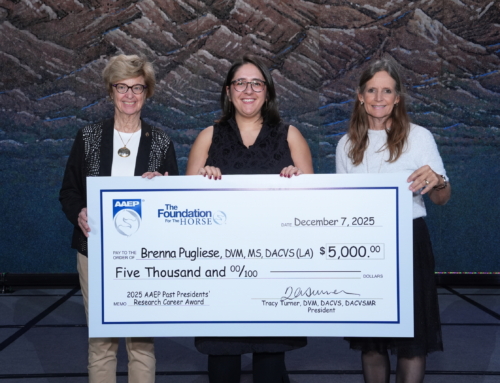
Brenna Pugliese, DVM, MS, DACVS, a Ph.D. candidate at North Carolina State University College of Veterinary Medicine, received the American Association of Equine Practitioners (AAEP) Past Presidents’ Research Career Award. Her current Ph.D. research, under the supervision of Lauren Schnabel, DVM, Ph.D., DACVS, DACVSMR, involves conducting the first investigations of the orthobiologic alpha-2-macroglobulin (A2M) as a potential treatment for equine osteoarthritis (OA). Specifically, her work is investigating the effects of a commercially available A2M product, Alpha2EQ®, on equine joint cells in vitro.
“Our early results suggest that Alpha2EQ could intervene in the earliest stages of equine OA by regulating the gene expression in cells of the inflamed synovium,” Pugliese stated. “Currently, there is no disease-modifying therapy available to treat OA, a disease that limits equine athletic performance and impacts the human-animal bond. My work on A2M has the potential to change this landscape for horses and their owners.”
“The veterinary profession strives to improve equine health and welfare through innovation, research discovery, and education,” said Carrie Finno. DVM, Ph.D., DACVIM (LAIM), Foundation Research Working Group chair. “The AAEP Past Presidents’ Research Career Award continues to be an important way to validate young veterinary graduates entering careers in research which will ultimately benefit horse welfare.”
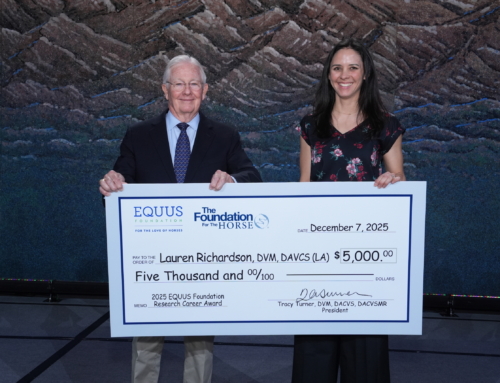
Lauren Richardson, DVM, DACVS-LA, a Ph.D. candidate at the University of Georgia, was honored with the EQUUS Foundation Research Career Award, presented in partnership with The Foundation for the Horse. Her research focuses on investigating the effects of oxidative stress on the intestinal mucosal barrier, using NSAID-induced oxidative injury and equine intestinal organoids as a model of intestinal barrier dysfunction in horses. Understanding this unique susceptibility in horses could reveal intervention strategies targeting oxidative damage pathways in equine intestinal disease and help identify oxidative mechanisms of NSAID-induced right dorsal colitis and other gastrointestinal injuries.
“The health and welfare of America’s horses is core to the mission of the EQUUS Foundation. We are honored to partner with The Foundation for the Horse through the EQUUS Foundation Research Fellowship to support veterinarians who are dedicating their careers to equine research,” said EQUUS Foundation Chair Jenny Belknap Kees.
These awards were formally presented during the American Association of Equine Practitioners 71st Annual Convention in Denver on Dec. 8, 2025.
About The Foundation for the Horse
Established in 1994, The Foundation for the Horse is a 501(c)(3) charitable organization transforming the lives of horses through equine veterinary education and scholarships, equine medical research, natural disaster relief, and support for working equids and horses in need around the world. As the charitable arm of the AAEP, The Foundation awards more than $1 million annually in scholarships, grants, and program support to help horses worldwide. To learn more, visit FoundationForTheHorse.org.
About the EQUUS Foundation
The EQUUS Foundation, a 501(c)(3) public charity established in 2002, is the only national animal welfare charity and accrediting body in the United States that is 100% dedicated to equine welfare with the dual mission to protect America’s horses from peril and strengthen the bond between people and horses. Its mission is to improve the quality of life of horses, promote the use of horses to enrich the lives of those in need, and educate the public about the horse’s unique ability to empower, teach, and heal. To learn more, visit equusfoundation.org.